
The slice is the most common ball flight error in the game of golf. For a right handed player, the slice is defined as a ball that starts to the left of the target, and then ultimately curves to the right of the target. For a left handed golfer, the ball starts to the right and curves to the left. It has been estimated by such teaching professionals as Hank Haney that at least 80% of all golfers slice the ball. Hank would definitely know, as he has given over 40,000 lessons in his career.
Unfortunately, there is a lot of bad advice in the world of golf when it comes to providing good information how to cure the golf slice. Some pros will simply tell you to set up to the ball with the club face closed (aimed to the left for a right handed player) to your target line, and it will ultimately be square to the target at impact. Other pros will tell you to swing out to right field, and still others will tell you to rotate your hands through the hitting zone.
Fortunately, there is a better way. First of all, it is necessary for the golfer to gain an understanding of the swing plane and how it affects ball flight. Golfers who tend to slice the ball as I have defined typically attack the ball from outside, or above the swing plane. In other words, for a right handed player, the swing path is coming in from the right and heading to the left. Since the right handed player is standing beside the ball, a good swing will result in the club attacking the ball from the inside, rather than the outside.
A swing plane that is coming in from outside and above the correct swing plane, or plane angle achieved as you address the ball (the angle of the club shaft) also has a tendency to result in the club face being open to the swing path at impact. This causes a rightward spin on the ball, which causes it to curve to the right.
There are basically two types of swings that will cause the club to attack the ball from outside the swing plane. The first is a swing with a loop, where the right handed player pulls the club too far inside on the take away, and then loops the club at the top of the swing that it attacks the ball from the outside in the down swing. The other type is simply one in which the player’s alignment and set up result in a steep outside takeaway that and failure to loop the club back to the inside in the down swing. In other words, the club returns to the ball from the same direction as the take away.
In both cases, the cure is quite easy. In the first instance, the golfer must simply learn to reverse the loop they have in their swing. Instead of pulling the club too far inside in the takeaway, and looping it back to the outside in the down swing, they should do the opposite, and perform a take away more to the outside in the back swing, and then loop the club back to the inside in the down swing. Jim Furyk’s swing is a perfect example of this move. Ultimately, the golfer wants to find the happy place in the middle and execute a swing that is more on plane in the back swing, which makes it easier to keep on plane in the down swing.
In the second instance, the golfer needs to feel what it is like to swing the club on a flatter swing plane. One way to do this is to perform a number of swings at chest level, then drop the club about a foot, perform more swings, and keep dropping the club about a foot at a time until it is set up at ground level. A flatter swing plane allows the golfer to square the clubface more easily at impact.
In both cases, it is a good idea to practice these drills with a ball on a tee. When you are able to hit a draw off of the tee consistently, you will be ready to hit the ball of the ground with confidence. Ultimately, getting rid of the slice requires a golf swing that is more on plane, and one in which the lower body starts the down swing. Most golfers slice the ball because of a poor swing plane and poor sequencing of the body.
Scott Cole www.yourgolfswingfix.com
Showing posts with label Golf exercise. Show all posts
Showing posts with label Golf exercise. Show all posts
Tuesday, November 8, 2011

Wednesday, January 19, 2011
Golf Tip of the Day - Strength Training
As winter drags on here throughout much of the U.S., many golfers turn to fitness as a way to improve their golf game. There is an entire industry devoted to the subject, and Tiger Woods can take credit for putting fitness at the forefront for golfers.
Most of the fitness related information for golfers is what is called "golf specific." Exercises are developed to help golfers increase range of motion and add some strength in areas where they are weak. Many of the exercises employ the use of training bands, balance balls and such. Traditional strength training is practically non-existent, but is it important?
My opinion is that if you are going to try to improve your golf game through fitness training you should incorporate at least some traditional strength training into your routine. The point is that you are likely performing many other activities outside of golf that require some strength, so why only perform golf specific exercises?
Your golf fitness routines should attack these areas...strength, balance, increased range of motion and speed. Many golf specific exercises will try to attack two or more of these areas at once. Many strength trainers will steer clear of traditional strength training because they feel it only attacks the strength area and may lead to too much bulk.
However, when done properly, traditional strength training will increase your range of motion, and it will help increase the strength of the big muscles a bit more rapidly. For instance, if you are seated on a stable surface, you will be able to handle more weight with a dumbbell press compared to if you are seated on a balance ball. The balance ball will incorporate the core muscles for stabilization, however, you simply won't be able to handle as much weight. If pure strength is what you are looking for in the specific muscle group you are exercising, then you need a stable platform.
With all this in mind, I feel it is a good idea to add traditional strength training into the mix. For myself, this means the use of traditional barbells and dumbbells. I train with these twice each week, and on other days I focus on cardio routines, some yoga, plyometrics and some more golf specific exercises. I believe golfers can benefit by incorporating a little of all of these areas into their routines. Lean, strong and flexible is the goal!
Scott Cole
www.howtogolfyourbest.com
Most of the fitness related information for golfers is what is called "golf specific." Exercises are developed to help golfers increase range of motion and add some strength in areas where they are weak. Many of the exercises employ the use of training bands, balance balls and such. Traditional strength training is practically non-existent, but is it important?
My opinion is that if you are going to try to improve your golf game through fitness training you should incorporate at least some traditional strength training into your routine. The point is that you are likely performing many other activities outside of golf that require some strength, so why only perform golf specific exercises?
Your golf fitness routines should attack these areas...strength, balance, increased range of motion and speed. Many golf specific exercises will try to attack two or more of these areas at once. Many strength trainers will steer clear of traditional strength training because they feel it only attacks the strength area and may lead to too much bulk.
However, when done properly, traditional strength training will increase your range of motion, and it will help increase the strength of the big muscles a bit more rapidly. For instance, if you are seated on a stable surface, you will be able to handle more weight with a dumbbell press compared to if you are seated on a balance ball. The balance ball will incorporate the core muscles for stabilization, however, you simply won't be able to handle as much weight. If pure strength is what you are looking for in the specific muscle group you are exercising, then you need a stable platform.
With all this in mind, I feel it is a good idea to add traditional strength training into the mix. For myself, this means the use of traditional barbells and dumbbells. I train with these twice each week, and on other days I focus on cardio routines, some yoga, plyometrics and some more golf specific exercises. I believe golfers can benefit by incorporating a little of all of these areas into their routines. Lean, strong and flexible is the goal!
Scott Cole
www.howtogolfyourbest.com
Thursday, December 23, 2010
Golf Tip of the Day - How to Stretch
As many golfers know, improved flexibility can help to improve your golf swing by allowing you to have a bigger shoulder turn, create a wider swing arc, and maintain posture throughout the swing. However, much of what I read on the golf forums on how to stretch is not healthy.
If you are seeking to increase your overall flexibility, it is NOT necessary to stretch hard every day. In fact, that would do more harm than good. It is, however, necessary to do some light stretching before your round of golf or practice session, and helpful to do some light stretching afterward.
When you stretch for increased flexibility, keep these tips in mind....
1. You only need to stretch for increased flexibility 2 or 3 times per week.
2. With each stretch, ease into the stretch, and never bounce when you are in the stretch. That is a good way to cause injury.
3. Hold your position for 30 to 45 seconds, and be sure to breathe. Get into your initial position where you feel discomfort, hold it for 15 seconds, then try to increase the stretch slightly and hold for another 15 to 30 seconds.
4. Always remember to breathe and try to keep the rest of your body as relaxed as possible.
5. When you are finished with the stretch, come out of the position very slowly.
6. Try to hit the major muscle groups when you stretch. Of utmost importance to golfers are the hamstrings, glutes, back, lats, shoulders and neck.
7. Give yourself 30 to 45 minutes to do your stretching routine and take your time!
Keep these tips in mind and you should start to see results after just a couple weeks. If you have any very tight areas, there may be an injury, so be sure to get checked out. Never, ever stretch beyond your limits...if you have pain, back off!
Scott Cole
www.howtogolfyourbest.com
If you are seeking to increase your overall flexibility, it is NOT necessary to stretch hard every day. In fact, that would do more harm than good. It is, however, necessary to do some light stretching before your round of golf or practice session, and helpful to do some light stretching afterward.
When you stretch for increased flexibility, keep these tips in mind....
1. You only need to stretch for increased flexibility 2 or 3 times per week.
2. With each stretch, ease into the stretch, and never bounce when you are in the stretch. That is a good way to cause injury.
3. Hold your position for 30 to 45 seconds, and be sure to breathe. Get into your initial position where you feel discomfort, hold it for 15 seconds, then try to increase the stretch slightly and hold for another 15 to 30 seconds.
4. Always remember to breathe and try to keep the rest of your body as relaxed as possible.
5. When you are finished with the stretch, come out of the position very slowly.
6. Try to hit the major muscle groups when you stretch. Of utmost importance to golfers are the hamstrings, glutes, back, lats, shoulders and neck.
7. Give yourself 30 to 45 minutes to do your stretching routine and take your time!
Keep these tips in mind and you should start to see results after just a couple weeks. If you have any very tight areas, there may be an injury, so be sure to get checked out. Never, ever stretch beyond your limits...if you have pain, back off!
Scott Cole
www.howtogolfyourbest.com
Friday, November 19, 2010
Golf Tip of the Day - How to Increase Your Swing Speed
I just read a forum post in a relatively popular golf instruction site and the golfer who wrote it was bragging about getting his swing speed up over 130 mph. The gentleman in question mentioned that he is 57 years old, and accomplished this by doing a particular workout for about a week and a half. He went from 106 to 131 in that period of time.
Time for a reality check folks. That swing speed would put him among the top 5 longest hitters on the PGA Tour. Tiger Woods and Phil Mickelson can get their swing speed up to that level when they go at it hard. They typically average about 125 mph. The average swing speed on tour is 112 mph.
A 57 year old man can not accomplish a 25 mph increase in swing speed in less than two weeks. I would venture to guess that there are fewer than twenty 57 year olds on the planet that can swing the club at 131 mph, if there are any at all. A 131 mph swing speed would translate into a carry of over 325 yards, and probably closer to 350 yards. Jamie Sadlowski, the two time defending ReMax world long drive champion swings the club at 145 mph. The funny thing is, the people in the forum were actually congratulating this guy, because they really have no clue.
It is possible to increase your swing speed significantly, but it takes a long period of time and work.
Here is what needs to happen to see a dramatic increase in swing speed.
1. You likely need to improve your technique. If you have a major swing flaw such as a reverse pivot or over the top swing, you will have great difficulty increasing your speed.
2. You need to increase your flexibility so you can swing the club on a bigger arc.
3. You need to increase your strength. Golf specific exercises will help, but you will really need to train like an athlete. Just look at today's long drive champions...they train hard!
4. You need to increase your body speed. This is done through the incorporation of plyometrics into the training routine.
5. You need to get on the range and learn how to swing the club faster without losing control.
I have had success with reasonably talented golfers in achieving increases of swing speed of near 10 mph in a single lesson, but that was due to an improvement in technique. I likely could not get another 10 mph in swing speed from them without training them like serious athletes.
I intend to put myself through more rigorous training over the winter to see what I can do about increasing my own swing speed. I could stand to shape a bit anyhow, so I will turn this into an experiment. My training will consist of a mix of typical free weight training, some P90X training which includes some plyometrics, yoga and some excellent core work, cardo training and more flexibility training. I take some measurements in the next week and follow up on this on a monthly basis.
Scott Cole
www.howtogolfyourbest.com\
www.powergolftraining.net
Time for a reality check folks. That swing speed would put him among the top 5 longest hitters on the PGA Tour. Tiger Woods and Phil Mickelson can get their swing speed up to that level when they go at it hard. They typically average about 125 mph. The average swing speed on tour is 112 mph.
A 57 year old man can not accomplish a 25 mph increase in swing speed in less than two weeks. I would venture to guess that there are fewer than twenty 57 year olds on the planet that can swing the club at 131 mph, if there are any at all. A 131 mph swing speed would translate into a carry of over 325 yards, and probably closer to 350 yards. Jamie Sadlowski, the two time defending ReMax world long drive champion swings the club at 145 mph. The funny thing is, the people in the forum were actually congratulating this guy, because they really have no clue.
It is possible to increase your swing speed significantly, but it takes a long period of time and work.
Here is what needs to happen to see a dramatic increase in swing speed.
1. You likely need to improve your technique. If you have a major swing flaw such as a reverse pivot or over the top swing, you will have great difficulty increasing your speed.
2. You need to increase your flexibility so you can swing the club on a bigger arc.
3. You need to increase your strength. Golf specific exercises will help, but you will really need to train like an athlete. Just look at today's long drive champions...they train hard!
4. You need to increase your body speed. This is done through the incorporation of plyometrics into the training routine.
5. You need to get on the range and learn how to swing the club faster without losing control.
I have had success with reasonably talented golfers in achieving increases of swing speed of near 10 mph in a single lesson, but that was due to an improvement in technique. I likely could not get another 10 mph in swing speed from them without training them like serious athletes.
I intend to put myself through more rigorous training over the winter to see what I can do about increasing my own swing speed. I could stand to shape a bit anyhow, so I will turn this into an experiment. My training will consist of a mix of typical free weight training, some P90X training which includes some plyometrics, yoga and some excellent core work, cardo training and more flexibility training. I take some measurements in the next week and follow up on this on a monthly basis.
Scott Cole
www.howtogolfyourbest.com\
www.powergolftraining.net
Thursday, November 18, 2010
Golf Tip of the Day - Start Stretching
Golf season is winding down here in the northern states, but that doesn't mean you should completely forget about your game over the winter months. You can make some major improvements without touching a golf club, although I would highly recommend that you keep swinging, somewhere, just to keep that muscle memory.
If you haven't already, now is a good time to add a stretching routine into your golf improvement program. But, before you do so, I highly recommend getting together with a physical therapist to get yourself evaluated first. Many of us have developed some physical issues over time, and these can result in muscle tightness in various parts of the body. However, simple, passive stretching exercises will not do much to loosen those muscles up until you identify the cause of the tightness first.
Get together with your physical therapist to identify the causes of any muscle tightness you may have, and then they will also be able to put you on the appropriate stretching and physical therapy routine to help alleviate these issues. It is usually recommended that strength training and active stretching exercises be performed as well.
Do yourself a favor, invest a little time into getting your body evaluated and you will go a lont way toward making those improvements in your golf swing you so desire.
Scott Cole
www.howtogolfyourbest.com
If you haven't already, now is a good time to add a stretching routine into your golf improvement program. But, before you do so, I highly recommend getting together with a physical therapist to get yourself evaluated first. Many of us have developed some physical issues over time, and these can result in muscle tightness in various parts of the body. However, simple, passive stretching exercises will not do much to loosen those muscles up until you identify the cause of the tightness first.
Get together with your physical therapist to identify the causes of any muscle tightness you may have, and then they will also be able to put you on the appropriate stretching and physical therapy routine to help alleviate these issues. It is usually recommended that strength training and active stretching exercises be performed as well.
Do yourself a favor, invest a little time into getting your body evaluated and you will go a lont way toward making those improvements in your golf swing you so desire.
Scott Cole
www.howtogolfyourbest.com
Tuesday, October 26, 2010
The Golf Swing and Back Pain
One of the topics that a number of the online golf swing gurus are hitting upon these days is the back pain that can be caused by the golf swing. Some of the online teaching pros go as far as to claim that their golf swing model is endorsed by medical professionals, or is scientifically proven. One teacher may suggest that the two-plane swing is the culprit, while another may indicate that the more modern and athletic, rotational swing is the culprit.
So with all this conflicting information being thrown at you, what is the true answer? I really don't know, but here is my two cents. It all depends on the individual.
The golf swing, no matter what model you subscribe to, is a complex athletic move. I know, I know, contrary to what is being sold to the public, the golf swing is not SIMPLE! What athletic move that incorporates just about every single muscle in the body at one moment or another can possibly be described as simple?
So, due to the fact that the golf swing itself is a complex athletic move, and no two human bodies are exactly alike, then it is no wonder that some people can develop back pain by using a one plane swing, two plane swing, or any other swing. Jack Nicklaus, Lee Trevino, Fred Couples, Seve Ballesteros and even Rory McIlroy have suffered from back pain. They all have very different golf swings. The only common thread is that they play golf.
Back pain for golfers can come from a variety of sources. Those who walk most of the time and may have foot issues may develop back pain. Those who walk and carry their golf bags can develop back pain. Those who are significantly over weight can develop back pain.
The only real way to fight it is not by switching to a new golf swing. Sure, a tweak here or there may alleviate some of the issues. It was revealed that Butch Harmon has Fred Couples hitting a draw this year to help alleviate some of the back pain, and Fred appeared to be doing well up through late Spring, but the issue did come back later in the season.
So, the best way to fight back issues is to strengthen the back, get it more flexible, and work on some of the spinal alignment issues, if you have any. I personally have some back issues, but I avoid major flare ups by continuing to do my core muscle workouts at least semi-regularly, stretch at least a little, and use my Tru Back device for alignment. The spine requires consistent attention. If none is given, any complex athletic move or activity is bound to result in wear and tear.
Do yourself a favor. If you have back issues, don't imagine for one second that a different golf swing will be the cure. The fact is, changing the overall shape of your golf swing takes a lot more work, than just a viewing of a video. Remember how long it took Tiger Woods to incorporate the changes he made to his swing with Hank Haney...over a year. Subtle change can be made, but major changes take time and practice.
Take care of your back instead. Take the time every day to loosen it up and stretch it out a bit. Consider taking some yoga classes and picking up an alignment device like the Tru Back or an inversion table. If needed, go to a chiropractor. If you take care of your back consistently, you will be much better off in the long run.
Scott Cole
www.powergolftraining.net
So with all this conflicting information being thrown at you, what is the true answer? I really don't know, but here is my two cents. It all depends on the individual.
The golf swing, no matter what model you subscribe to, is a complex athletic move. I know, I know, contrary to what is being sold to the public, the golf swing is not SIMPLE! What athletic move that incorporates just about every single muscle in the body at one moment or another can possibly be described as simple?
So, due to the fact that the golf swing itself is a complex athletic move, and no two human bodies are exactly alike, then it is no wonder that some people can develop back pain by using a one plane swing, two plane swing, or any other swing. Jack Nicklaus, Lee Trevino, Fred Couples, Seve Ballesteros and even Rory McIlroy have suffered from back pain. They all have very different golf swings. The only common thread is that they play golf.
Back pain for golfers can come from a variety of sources. Those who walk most of the time and may have foot issues may develop back pain. Those who walk and carry their golf bags can develop back pain. Those who are significantly over weight can develop back pain.
The only real way to fight it is not by switching to a new golf swing. Sure, a tweak here or there may alleviate some of the issues. It was revealed that Butch Harmon has Fred Couples hitting a draw this year to help alleviate some of the back pain, and Fred appeared to be doing well up through late Spring, but the issue did come back later in the season.
So, the best way to fight back issues is to strengthen the back, get it more flexible, and work on some of the spinal alignment issues, if you have any. I personally have some back issues, but I avoid major flare ups by continuing to do my core muscle workouts at least semi-regularly, stretch at least a little, and use my Tru Back device for alignment. The spine requires consistent attention. If none is given, any complex athletic move or activity is bound to result in wear and tear.
Do yourself a favor. If you have back issues, don't imagine for one second that a different golf swing will be the cure. The fact is, changing the overall shape of your golf swing takes a lot more work, than just a viewing of a video. Remember how long it took Tiger Woods to incorporate the changes he made to his swing with Hank Haney...over a year. Subtle change can be made, but major changes take time and practice.
Take care of your back instead. Take the time every day to loosen it up and stretch it out a bit. Consider taking some yoga classes and picking up an alignment device like the Tru Back or an inversion table. If needed, go to a chiropractor. If you take care of your back consistently, you will be much better off in the long run.
Scott Cole
www.powergolftraining.net
Thursday, October 14, 2010
Golf Swing Feeling Tight in the cold weather? Stretch more!
Today I headed over to Olney Golf Park where I teach here near Rockville, Maryland, and after my one lesson today, I decided to hit some golf balls. My student is a beginner, and today we simply worked on how she should move her body through the swing, so she did not hit many balls. So I ended up with two large buckets of balls, or about 200 balls to hit. It was a cold and wet day here in Maryland, and I was still a bit tight from my upper body workout the other day, and I've had a kink in my neck the last couple days.
While I hit the ball ok, it was clear I was not hitting with the power I am used to. As the session wore on, I could feel my swing becoming more compact, and I was not getting any extension through the ball. This was quite evident when I decided to try hitting one driver, which ended up being a low hook. I knew it was time to end the session with some short pitch shots.
I have not spent much time on my stretching for a while, but now that the weather has turned cold, it is even more important to make sure I do. This goes for any golfer. Colder weather makes us tighter, and that leaves us with less efficient, less powerful golf swing. Not only should we take more time to get warmed up and stretch before practice or a round of golf, we should do more at home as well.
If you do not have a stretching program, I highly recommend starting one. I learned quite a few stretches in my martial arts and yoga training, and will begin to implement them even more as I finally start to settle into a routine here in Maryland. I recommend you get started as well! Keep an eye out for more fitness information here at scottcolegolf.com in the future! You can also visit my Power Golf Training website to obtain my Principles of Power Golf ebook.
Scott Cole
While I hit the ball ok, it was clear I was not hitting with the power I am used to. As the session wore on, I could feel my swing becoming more compact, and I was not getting any extension through the ball. This was quite evident when I decided to try hitting one driver, which ended up being a low hook. I knew it was time to end the session with some short pitch shots.
I have not spent much time on my stretching for a while, but now that the weather has turned cold, it is even more important to make sure I do. This goes for any golfer. Colder weather makes us tighter, and that leaves us with less efficient, less powerful golf swing. Not only should we take more time to get warmed up and stretch before practice or a round of golf, we should do more at home as well.
If you do not have a stretching program, I highly recommend starting one. I learned quite a few stretches in my martial arts and yoga training, and will begin to implement them even more as I finally start to settle into a routine here in Maryland. I recommend you get started as well! Keep an eye out for more fitness information here at scottcolegolf.com in the future! You can also visit my Power Golf Training website to obtain my Principles of Power Golf ebook.
Scott Cole
Tuesday, September 28, 2010
Ryder Cup
The Ryder Cup matches between the U.S. and Europe begin Friday with the Europeans a heavy favorite to win back the cup. I have to agree with the consensus in that regard. One of the big wild cards of course is whether Tiger has found his game over the last two weeks while continuing his work with Sean Foley. He spoke positively at his news conference today.
The European side looks loaded, but with the glaring exception of Phil Mickelson, the American side is entering the event in pretty good form. Home field advantage to the Europeans though.
On another note, in recent weeks I have been trying to simplify my own golf swing a little bit by simply focusing on what my body is doing during the swing, and forgetting about takeaway positions and the position of my hands at the top. I am trying to swing the arms more behind my body, and then I am trying to be more aggressive with my lower body in the down swing by turning the hips a little more aggressively. The end result has been that I am striking the ball better than I ever have, EVER!
One key test of this swing will come tomorrow. I have not touched a club in a week due to a little time off. I am back at Olney Golf Park tomorrow to practice and give instruction. Normally, I would expect to be a bit off with my ball striking after a little lay off, just due to timing. But, I think I grooved this swing pretty well this time, so we'll see.
Scott Cole
www.onlinegolfswingcoach.com
www.scottcolegolf.com
www.powergolftraining.net
The European side looks loaded, but with the glaring exception of Phil Mickelson, the American side is entering the event in pretty good form. Home field advantage to the Europeans though.
On another note, in recent weeks I have been trying to simplify my own golf swing a little bit by simply focusing on what my body is doing during the swing, and forgetting about takeaway positions and the position of my hands at the top. I am trying to swing the arms more behind my body, and then I am trying to be more aggressive with my lower body in the down swing by turning the hips a little more aggressively. The end result has been that I am striking the ball better than I ever have, EVER!
One key test of this swing will come tomorrow. I have not touched a club in a week due to a little time off. I am back at Olney Golf Park tomorrow to practice and give instruction. Normally, I would expect to be a bit off with my ball striking after a little lay off, just due to timing. But, I think I grooved this swing pretty well this time, so we'll see.
Scott Cole
www.onlinegolfswingcoach.com
www.scottcolegolf.com
www.powergolftraining.net
Friday, June 25, 2010
My Golf Game Continuing To Improve
It has now been about 16 months since I attended my first Hank Haney Teaching the Teacher seminar, where I received a lesson from Hank himself. During that lesson, Hank worked on improving my posture, my takeaway, a better position at the top of my backswing, a better position in the downswing, and a better follow through. For many students, this would be quite a lot to work on, and admittedly, I often give students quite a bit of information during that first lesson. My thinking is that if I can do it, anyone can.
Improving your golf game is a process. Not all of the improvements will come at once. It is important to focus on one or two things at a time, and then when you have made improvement to them, work on the next couple of things. I feel that the student can progress much faster if they take notes as well.
Anyhow, after 16 months, I feel like I am getting very close to my best golf, even while I only play once or twice per month. I have learned so much about the golf swing and golf course management, that I don't need to play every day like I used to growing up in order to play well.
Today I played a nice golf course in Maryland, and played my best round since my lesson with Hank last year...an even par 72. While I did make two long putts, I did have several three putts and missed another short putt for birdie. I also had a couple unforced errors with wedges. This course is more difficult than most I usually play locally, so I feel pretty good about the score. If I were playing more regularly, there would not be as many three putts or missed greens with a wedge in my hand.
Last year when I went to Dallas to attend that seminar, I really had no clue with my golf game. Now, I realize that if I actually find more time to play and practice, I can probably be a better golfer than I have ever been.
I am writing this post because I think it is necessary for students to track their results and performance. If I can improve after one lesson with Hank, and some follow up feedback at this year's seminar from two of his senior instructors, Brian Mahon and Doug Alexander, then any student can improve. However, it requires time, patience, effort, and a willingness to make changes. If you have some of that going for you, the sky is the limit!
One final word...just like Ray Romano on the Haney Project, I find that many students think they will get worse before they get better following a lesson....that is utter nonsense. Get that out of your head. If you will do what your instructor tells you to do, assuming they are a good instructor, you should see improvement right away. But, you must keep an open mind. I started improving from Day One. You can too.
Scott Cole
www.powergolftraining.net
www.onlinegolfswingcoach.com
Improving your golf game is a process. Not all of the improvements will come at once. It is important to focus on one or two things at a time, and then when you have made improvement to them, work on the next couple of things. I feel that the student can progress much faster if they take notes as well.
Anyhow, after 16 months, I feel like I am getting very close to my best golf, even while I only play once or twice per month. I have learned so much about the golf swing and golf course management, that I don't need to play every day like I used to growing up in order to play well.
Today I played a nice golf course in Maryland, and played my best round since my lesson with Hank last year...an even par 72. While I did make two long putts, I did have several three putts and missed another short putt for birdie. I also had a couple unforced errors with wedges. This course is more difficult than most I usually play locally, so I feel pretty good about the score. If I were playing more regularly, there would not be as many three putts or missed greens with a wedge in my hand.
Last year when I went to Dallas to attend that seminar, I really had no clue with my golf game. Now, I realize that if I actually find more time to play and practice, I can probably be a better golfer than I have ever been.
I am writing this post because I think it is necessary for students to track their results and performance. If I can improve after one lesson with Hank, and some follow up feedback at this year's seminar from two of his senior instructors, Brian Mahon and Doug Alexander, then any student can improve. However, it requires time, patience, effort, and a willingness to make changes. If you have some of that going for you, the sky is the limit!
One final word...just like Ray Romano on the Haney Project, I find that many students think they will get worse before they get better following a lesson....that is utter nonsense. Get that out of your head. If you will do what your instructor tells you to do, assuming they are a good instructor, you should see improvement right away. But, you must keep an open mind. I started improving from Day One. You can too.
Scott Cole
www.powergolftraining.net
www.onlinegolfswingcoach.com
Saturday, June 19, 2010
Tiger Makes Presence Felt at Pebble Beach
Tiger Woods' golf game has apparently returned today, with a 66 in the third round of the U.S. Open at Pebble Beach. In a stunning display of ball striking and clutch putting, Tiger should be a force on Sunday.
Meanwhile, Phil Mickelson was unable to follow through on his second round 66. Struggling from the start, Phil is fighting just to stay in contention. Ernie Els seems unable to make a putt, otherwise he would still be about even with Tiger.
So far, the leaders remain Graeham McDowell and Dustin Johnson. Which means, Tiger will be favored to win on Sunday.
Scott Cole
www.powergolftraining.com
Meanwhile, Phil Mickelson was unable to follow through on his second round 66. Struggling from the start, Phil is fighting just to stay in contention. Ernie Els seems unable to make a putt, otherwise he would still be about even with Tiger.
So far, the leaders remain Graeham McDowell and Dustin Johnson. Which means, Tiger will be favored to win on Sunday.
Scott Cole
www.powergolftraining.com
Monday, May 31, 2010
Golfers, Learn Better Short Game Technique And Take Notes!
I give quite a few golf lessons involving the short game. With most people, if they have been playing the game for a while, I watch them hit a few shots first. The first shot I watch them hit is where they are just a few feet off the edge of the green, maybe on the fringe or in the short rough, and they have about 40 to 50 feet of green to work with. In 90% of the cases, the student will pull out a sand wedge or pitching wedge and try to fly the ball halfway to the hole. They have trouble getting it within 15 feet.
I calmly step up and chip the shot with a 7 or 8 iron and with the first second ball, I am within 2 feet.
We have all this information out there regarding the golf game from the internet to the major magazines, to a tv channel devoted to the game, and yet most people show no improvement. Are they not paying attention?
Yes, there is an awful lot of information about the game to assimilate over time. So, my best advice to the golfer who wants to improve is to take notes!
I studied Pai Lum Kung Fu for 8 years, and I have a notebook that is three inches thick full of typewritten notes on all the forms, techniques and details how to perform each. Golf is similar in that there is a lot to learn. But, how can you improve if you don't remember the proper technique?
You see, if you want to make improvements, you have to take accountability! As a teacher, I can only bring the horse to water, but I can't make it drink!
From now on, take some notes, and when you go practice, take them with you! I guarantee you will start to see better results.
Scott Cole
www.onlinegolfswingcoach.com
www.powergolftraining.net
I calmly step up and chip the shot with a 7 or 8 iron and with the first second ball, I am within 2 feet.
We have all this information out there regarding the golf game from the internet to the major magazines, to a tv channel devoted to the game, and yet most people show no improvement. Are they not paying attention?
Yes, there is an awful lot of information about the game to assimilate over time. So, my best advice to the golfer who wants to improve is to take notes!
I studied Pai Lum Kung Fu for 8 years, and I have a notebook that is three inches thick full of typewritten notes on all the forms, techniques and details how to perform each. Golf is similar in that there is a lot to learn. But, how can you improve if you don't remember the proper technique?
You see, if you want to make improvements, you have to take accountability! As a teacher, I can only bring the horse to water, but I can't make it drink!
From now on, take some notes, and when you go practice, take them with you! I guarantee you will start to see better results.
Scott Cole
www.onlinegolfswingcoach.com
www.powergolftraining.net
Saturday, May 29, 2010
The Principles of Power Golf
No matter what their skill level or experience, every golfer on the planet will always want to hit increase the power of their golf swing so they can hit 300 yard drives. That is why golfers are bombarded with all kinds of new drivers, golf swing gadgets, and golf fitness exercises that will supposedly allow them to add 10, 15, 25, even 75 yards to their tee shots.
I’ve read and seen so much garbage being sold to the every day golfer, it makes my stomach turn at times. As a professional golf instructor, competitive golfer, athlete and martial artist, I have a pretty good idea of what works and what doesn’t. For instance, if you have never exercised regularly and have a classic over the top golf swing that results in a big slice, doing a few wrist exercises and trunk twists with training bands is not going to let you add 30 yards to your tee shot.
There are essentially four key principles to power golf. The first principle of power golf is golf swing technique. The fact of the matter is that if you have a significantly flawed golf swing, it will drain power from your swing. I’ve had success with teaching students to hit the ball further by improving their golf swing. In one case, the student had a classic over the top swing with an early release of the hands. As a result, this student, who at the time was about 5’9, could barely hit the ball 200 yards with his driver. As this student is still quite young, he has grown a few inches, and improved his swing and now can CARRY the ball 250 yards.
Another student of mine is in his early 40’s and recently visited me in my old indoor teaching studio where we measured his swing speed on my simulator. He is actually a friend of mine with whom I have played with competitively. Standing about 6’1, he weighs about 230 pounds. Over time, his swing deteriorated into a severe inside out swing. He would always fight a big hook, and sometimes would just hit a block if he did not release his hands properly. At the beginning of his lesson, we measured his top speed at 98 mph. By the end of the lesson, he was at over 106 mph, as I had improved his swing path. If and when he gets used to this new swing, he will swing much faster.
So, the first Principle of Power Golf must be technique. If you improve your technique, you can definitely hit the ball further. It just takes good instruction and the desire to improve!
After improving your basic swing shape, the next thing that will help you increase your golf swing power is flexibility. This is the second Principle of Power Golf. I place flexibility above strength in terms of importance because if you have the flexibility to make a bit shoulder turn, you will have the ability to create a bigger arc with your swing, which is key to increased swing speed. I place flexibility above strength in importance because when I was 19, I won my first local long drive contest while weighing about 165 pounds (I am 6 feet tall). I was athletic, and fairly strong, but nowhere near as strong as I am now. However, I had the flexibility to make a big shoulder turn and arc with my swing, plus I have very flexible wrists that allow me to create significant lag in my swing. As a result, I was able to out drive many golfers that were bigger and stronger.
That is not to say that strength is not important. If you really want to take your golf swing power to another level, increased strength will do the job. As a result, strength is the third Principle of Power Golf. However, when I am talking about strength, I am talking about total body strength. If you want to increase your swing speed, you have to work out your entire body.
In my research of golf fitness, I have seen some ridiculous exercises being demonstrated. The idea behind these is that if you do a couple of these exercises for a few minutes, a couple days per week, you will hit the ball 25 yards further. This is utter nonsense. As with any endeavor, if you want to improve your golf game and golf swing power, it will take some work. The added benefit of strength training is that it will make you healthier overall, and more durable. So, to truly improve your power off the tee, be prepared to work your legs, your core, your chest, shoulders, back and arms.
The last Principle of Power Golf is body speed. The truly elite golfers and long drivers have incredible body speed, and this primarily innate. However, elite athletes are learning how to increase their speed through a variety of new exercises. Much of this training involves plyometrics and these types of exercises are generally reserved for athletes who are already in pretty good condition. If you are this type of golfer, training like an elite athlete will take you to the next level in your development.
World long drive champion Jamie Sadlowski exhibits all four of these Principles of Power Golf. He has an exceptionally powerful golf swing with a huge swing arc and tremendous wrist lag. He is incredibly flexible with an amazing shoulder turn and substantial hinge in his wrists. He works out like an elite athlete and is quite strong, even though he only weighs about 165 pounds. And finally, he has incredible body speed. The end result is that he can regularly hit the golf ball over 400 yards in competition.
While it won’t likely be possible for you to hit the ball over 400 yards, if you improve your technique, flexibility, strength and speed, you will definitely have the opportunity to hit the ball closer to, or over 300 yards!
Scott Cole
Power Golf Training
I’ve read and seen so much garbage being sold to the every day golfer, it makes my stomach turn at times. As a professional golf instructor, competitive golfer, athlete and martial artist, I have a pretty good idea of what works and what doesn’t. For instance, if you have never exercised regularly and have a classic over the top golf swing that results in a big slice, doing a few wrist exercises and trunk twists with training bands is not going to let you add 30 yards to your tee shot.
There are essentially four key principles to power golf. The first principle of power golf is golf swing technique. The fact of the matter is that if you have a significantly flawed golf swing, it will drain power from your swing. I’ve had success with teaching students to hit the ball further by improving their golf swing. In one case, the student had a classic over the top swing with an early release of the hands. As a result, this student, who at the time was about 5’9, could barely hit the ball 200 yards with his driver. As this student is still quite young, he has grown a few inches, and improved his swing and now can CARRY the ball 250 yards.
Another student of mine is in his early 40’s and recently visited me in my old indoor teaching studio where we measured his swing speed on my simulator. He is actually a friend of mine with whom I have played with competitively. Standing about 6’1, he weighs about 230 pounds. Over time, his swing deteriorated into a severe inside out swing. He would always fight a big hook, and sometimes would just hit a block if he did not release his hands properly. At the beginning of his lesson, we measured his top speed at 98 mph. By the end of the lesson, he was at over 106 mph, as I had improved his swing path. If and when he gets used to this new swing, he will swing much faster.
So, the first Principle of Power Golf must be technique. If you improve your technique, you can definitely hit the ball further. It just takes good instruction and the desire to improve!
After improving your basic swing shape, the next thing that will help you increase your golf swing power is flexibility. This is the second Principle of Power Golf. I place flexibility above strength in terms of importance because if you have the flexibility to make a bit shoulder turn, you will have the ability to create a bigger arc with your swing, which is key to increased swing speed. I place flexibility above strength in importance because when I was 19, I won my first local long drive contest while weighing about 165 pounds (I am 6 feet tall). I was athletic, and fairly strong, but nowhere near as strong as I am now. However, I had the flexibility to make a big shoulder turn and arc with my swing, plus I have very flexible wrists that allow me to create significant lag in my swing. As a result, I was able to out drive many golfers that were bigger and stronger.
That is not to say that strength is not important. If you really want to take your golf swing power to another level, increased strength will do the job. As a result, strength is the third Principle of Power Golf. However, when I am talking about strength, I am talking about total body strength. If you want to increase your swing speed, you have to work out your entire body.
In my research of golf fitness, I have seen some ridiculous exercises being demonstrated. The idea behind these is that if you do a couple of these exercises for a few minutes, a couple days per week, you will hit the ball 25 yards further. This is utter nonsense. As with any endeavor, if you want to improve your golf game and golf swing power, it will take some work. The added benefit of strength training is that it will make you healthier overall, and more durable. So, to truly improve your power off the tee, be prepared to work your legs, your core, your chest, shoulders, back and arms.
The last Principle of Power Golf is body speed. The truly elite golfers and long drivers have incredible body speed, and this primarily innate. However, elite athletes are learning how to increase their speed through a variety of new exercises. Much of this training involves plyometrics and these types of exercises are generally reserved for athletes who are already in pretty good condition. If you are this type of golfer, training like an elite athlete will take you to the next level in your development.
World long drive champion Jamie Sadlowski exhibits all four of these Principles of Power Golf. He has an exceptionally powerful golf swing with a huge swing arc and tremendous wrist lag. He is incredibly flexible with an amazing shoulder turn and substantial hinge in his wrists. He works out like an elite athlete and is quite strong, even though he only weighs about 165 pounds. And finally, he has incredible body speed. The end result is that he can regularly hit the golf ball over 400 yards in competition.
While it won’t likely be possible for you to hit the ball over 400 yards, if you improve your technique, flexibility, strength and speed, you will definitely have the opportunity to hit the ball closer to, or over 300 yards!
Scott Cole
Power Golf Training
Sunday, March 21, 2010
Hank Haney Seminar
Last weekend, I attended the annual Hank Haney Teach the Teacher seminar at his facility near Dallas. Once again, it was an excellent seminar as we had the opportunity to listen to Hank discuss his teaching philosophy along with his work with Tiger Woods, Charles Barkley and Ray Romano. Additionally, we were exposed to tons of new information that will help to benefit our students.
As a result of this new information, I will be adding a new service for my students involving a complete game evaluation. Once completed, a game plan will be developed which will focus on the areas of greatest need. Also, we'll be able to track the student's progress through the use of MyGolfGamePlan.com.
I'm looking forward to working with my existing and new students in 2010!
Scott Cole
www.scottcolegolf.com
www.powergolftraining.net
As a result of this new information, I will be adding a new service for my students involving a complete game evaluation. Once completed, a game plan will be developed which will focus on the areas of greatest need. Also, we'll be able to track the student's progress through the use of MyGolfGamePlan.com.
I'm looking forward to working with my existing and new students in 2010!
Scott Cole
www.scottcolegolf.com
www.powergolftraining.net
Saturday, February 27, 2010
Where is Mickelson?
The PGA Tour is visiting Phoenix this week, and Phil Mickelson is among the top players present this week. Yet, a check of the leaderboard finds Phil 9 shots behind the leader after Round 3, and even behind Champions Tour players Fred Couples and Tom Lehman, and soon to be Champions Tour player Mark Calcavecchia.
There is no doubt that after the way Phil finished 2009, there were high expectations for Phil. These expectations were raised higher since Tiger is nowhere to be found.
A check of the stats for Phil this week indicates one problem is driving accuracy. Once again, Phil can't find the fairway. He is ranked 65th in that stat. In today's round, he had 32 putts.
Not to worry. At some point, Phil will win. But, I don't think we can or should heap as much expectation on his shoulders as we have with Tiger. They are two different people, and two different golfers. Phil is a hit or miss golfer. When he is on his game, Tiger is his only rival. When he is off, he can miss the cut. Tiger was that way earlier in his career. He made the move to Hank Haney so that he could be a more consistent player and that is what he became. But, he was willing to make the changes that Haney suggested he needed to make. Most golfers are not willing to do that.
Watched another Anthony Kim meltdown today. A 76 in the 3rd round with an 8 on a par 5 on the back nine. This kid has the all the talent in the world, but I am not sure how devoted he is. He said in interviews this week that he worked hard in the off-season. He is known as a partier. He'll have a short career if that keeps up.
So, who is going to truly take over leadership in Tiger's absence? Steve Stricker has been on an amazing roll, but lost in the first round of the Match play championship last week. Still, I see him remaining consistent, and he seems to be in a good place mentally. I just don't see him winning a major.
I suspect it will be a European player that takes over the mantle in the short term. Harrington always seems hungry, even as he struggled with some swing changes last year. Ian Poulter just won the Match play last week, and Paul Casey again made a strong showing. Right now, it seems like the top talent is on the other side of the Atlantic, and they may push each other to new heights this year.
It should be an interesting year with some big events coming up in just a few short weeks!
Scott Cole
www.scottcolegolf.com
www.powergolftraining.net
There is no doubt that after the way Phil finished 2009, there were high expectations for Phil. These expectations were raised higher since Tiger is nowhere to be found.
A check of the stats for Phil this week indicates one problem is driving accuracy. Once again, Phil can't find the fairway. He is ranked 65th in that stat. In today's round, he had 32 putts.
Not to worry. At some point, Phil will win. But, I don't think we can or should heap as much expectation on his shoulders as we have with Tiger. They are two different people, and two different golfers. Phil is a hit or miss golfer. When he is on his game, Tiger is his only rival. When he is off, he can miss the cut. Tiger was that way earlier in his career. He made the move to Hank Haney so that he could be a more consistent player and that is what he became. But, he was willing to make the changes that Haney suggested he needed to make. Most golfers are not willing to do that.
Watched another Anthony Kim meltdown today. A 76 in the 3rd round with an 8 on a par 5 on the back nine. This kid has the all the talent in the world, but I am not sure how devoted he is. He said in interviews this week that he worked hard in the off-season. He is known as a partier. He'll have a short career if that keeps up.
So, who is going to truly take over leadership in Tiger's absence? Steve Stricker has been on an amazing roll, but lost in the first round of the Match play championship last week. Still, I see him remaining consistent, and he seems to be in a good place mentally. I just don't see him winning a major.
I suspect it will be a European player that takes over the mantle in the short term. Harrington always seems hungry, even as he struggled with some swing changes last year. Ian Poulter just won the Match play last week, and Paul Casey again made a strong showing. Right now, it seems like the top talent is on the other side of the Atlantic, and they may push each other to new heights this year.
It should be an interesting year with some big events coming up in just a few short weeks!
Scott Cole
www.scottcolegolf.com
www.powergolftraining.net
Sunday, February 7, 2010
Drive For Show, Putt For Dough!
This weekend's results at Riviera underscore how important it is to be able to putt well in this game of golf. Yet, when most people play and try and improve their golf game, they spend far more time on the driving range than on and around the practice green.
Steve Stricker has average power on the PGA Tour...he was 37th in driving distance this week. However, he won because he finished in the top 10 in greens in regulation, and had the fewest putts per round. He has simplified his swing quite a bit over the last few years, after fighting a hook for a long time. With today's win, he has leapfrogged Mickelson as the Number 2 ranked player in the world. Quite an achievement for a guy who struggled to keep his card a few years back.
When you start playing again this Spring, have a plan to make some improvements on your swing early in the season, then focus a lot more of your attention on your short game. The bottom line is that we want lower scores, and the easiest path to lower scores is around the green.
Scott Cole
powergolftraining.net
scottcolegolf.com
Steve Stricker has average power on the PGA Tour...he was 37th in driving distance this week. However, he won because he finished in the top 10 in greens in regulation, and had the fewest putts per round. He has simplified his swing quite a bit over the last few years, after fighting a hook for a long time. With today's win, he has leapfrogged Mickelson as the Number 2 ranked player in the world. Quite an achievement for a guy who struggled to keep his card a few years back.
When you start playing again this Spring, have a plan to make some improvements on your swing early in the season, then focus a lot more of your attention on your short game. The bottom line is that we want lower scores, and the easiest path to lower scores is around the green.
Scott Cole
powergolftraining.net
scottcolegolf.com
Shoveling Out
Snowmageddon hit us hard in Southcentral Pennsylvania, and yesterday afternoon was spent shoveling snow. As I've mentioned before, shoveling snow is a tremendous workout, assuming you are healthy enough to undertake this demanding work. We've all read numerous stories of heart attacks occurring while shoveling snow, so do not attempt to shovel out from a storm like this unless you have a clean bill of health from your doctor.
What are the benefits of shoveling snow? First, there is the calorie burn. A little research online indicated that snow shoveling can burn 100 calories or more in 15 minutes. Second, it is a great total body workout, as you are working the legs, core, arms and shoulders all in one exercise.
Obviously, if done improperly, you can injure your back. It is absolutely critical that you engage the legs, rather than do all of the work with the back. Yes, you still have to bend at the waist, and that will put some pressure on the back. But, if you engage the legs, you will simply get a good workout for the back.
Today, after 2 1/2 hours of shoveling 18 inches of snow from my driveway, I am modestly tender in the lower back, just as I would be in any muscle group the day after a good workout. That 2 1/2 hours of shoveling also indicates that I burned over 1,000 calories! So, not only did I get in a good strengthening workout for some key muscle groups, I contributed to my weight loss goal.
This is just one common sense activity you can perform to contribute to your golf fitness. There is no need to join a gym or buy any fancy equipment. Take advantage of these opportunities when they come along!
Scott Cole
powergolftraining.net
scottcolegolf.com
What are the benefits of shoveling snow? First, there is the calorie burn. A little research online indicated that snow shoveling can burn 100 calories or more in 15 minutes. Second, it is a great total body workout, as you are working the legs, core, arms and shoulders all in one exercise.
Obviously, if done improperly, you can injure your back. It is absolutely critical that you engage the legs, rather than do all of the work with the back. Yes, you still have to bend at the waist, and that will put some pressure on the back. But, if you engage the legs, you will simply get a good workout for the back.
Today, after 2 1/2 hours of shoveling 18 inches of snow from my driveway, I am modestly tender in the lower back, just as I would be in any muscle group the day after a good workout. That 2 1/2 hours of shoveling also indicates that I burned over 1,000 calories! So, not only did I get in a good strengthening workout for some key muscle groups, I contributed to my weight loss goal.
This is just one common sense activity you can perform to contribute to your golf fitness. There is no need to join a gym or buy any fancy equipment. Take advantage of these opportunities when they come along!
Scott Cole
powergolftraining.net
scottcolegolf.com
Sunday, January 31, 2010
It's Golf Season!
Ok, well, it's not really golf season here in Pennsylvania. But, now that the PGA Tour is in full swing, it's golf season in the U.S. For those of us not so fortunately to live in a more tropical climate, the season is not that far away. With that in mind, now is the time to brush up on the fundamentals!
The Grip
The Grip is THE single most important fundamental in the golf swing, as it is our ONLY connection to the golf club. Yet, it is probably the most ignored. Why is the grip so important? Because it controls the clubface angle at impact. The angle of the clubface at impact is most important to determining ball flight.
If the clubface is open at impact, the ball will likely fly to the right (assuming you are a right handed player). The club path then determines which direction the ball will start. If your club bath is inside out and the club face is open, the ball flight will be a push or a slice that starts to the right. If the clubpath is outside in, the ball will start left and slice to the right. An open clubface is typically caused by a weak grip. In other words, if you are a right handed player, your hands are turned to far to the left on the club. If you are a left handed player, your hands are turned to0 far to the right on the club.
If the clubface is closed at impact, the ball will likely fly to the left. If your club path is inside out, you will hit a shot that starts to the right and then curves back to the left. If your club path is outside in, the result will be a pull or pull hook. A closed clubface at impact is typically caused by a grip that is too strong. If you are a right handed player, your hands are turned too far to the right on the club. If you are a left handed player, your hands are turned too far to the left.
Ideally, what we would like is a NEUTRAL grip. So how do we achieve that? Here are the basic points....
(Right Handers)
1. Your left hand should be placed on the club so that the left thumb points down the club shaft at about 1 o'clock. If your thumb is straight down the shaft, it is too weak.
2. The V formed by your thumb and forefinger should be pointed between your right cheek and right shoulder. Then, if I am standing in front of you, I should only see two knuckles on the back of your left hand. If I see more than 2, your hand is turned too far to the right (too strong). If I see only 1, it is turned too far to the left (too weak).
3. Your right hand should be placed in such a way that the pad of the right thumb covers the left thumb. You then wrap your fingers around the club from there.
4. Your right thumb should be pointed at 11 o'clock down the club shaft.
5. The V formed by your thumb and forefinger should be pointed between your right cheek and right shoulder...parallel to the V formed by your left hand.
6. You should form a trigger with your right forefinger, and that trigger should be directly beside the right thumb, not underneath the club, and not on top of the grip.
When you place your hands on the club in this manner, the palms should be facing each other.
(Left Handers)
1. Your right hand should be placed on the club so that the right thumb points down the club shaft at 11 o'clock.
2. The V formed by your thumb and forefinger should point between your left cheek and shoulder.
3. Your left hand should be place so that the pad of the left thumb covers your right thumb. Wrap your fingers around the club from there.
4. Your left thumb should be pointed at 1 o'clock down the club shaft.
5. The V formed by your thumb and forefinger should point between your left cheek and shoulder, parallel to the V formed by your right hand.
6. Form a trigger with your left forefinger, and that trigger should be directly beside the thumb, not underneat the club and not on top of the grip.
Whether you work with an overlap grip, interlock grip or a 10 finger grip is up to you. I personally recommend not using the 10 finger grip as that results in the hands working more separately than we like. We want the hands to work as one unit throughout the swing.
Changing your grip is often an uncomfortable change, but it is the key to hitting more consistent golf shots. The only way to get more comfortable with the new grip is to work on it, practice with it. Swing the club in the garage so you get used to it during the winter months.
However, I do not recommend you change your grip under the following circumstances:
1. If you have a strong grip as described previously, but you still slice the ball, then do not try to achieve a more neutrual grip, as it will only worsen your slice. You have to work on your swing path first.
2. If you have a weak grip and still hook the ball, again, do not try to go to a more neutral grip, as you will only hook the ball more. You have to work on swing path first.
In regard to grip pressure, most golfers have a tendency to hold on to the club too tight. Most golfers tend to slice the ball, and holding onto the club too tightly will only make this worse. However, if you tend to hook the ball too much, try holding the club a little tighter. Ideally, we want medium grip pressure...not too tight and not too loose.
Work on this most important fundamental and in the long run, you will achieve greater consistency.
Scott Cole
scottcolegolf.com
powergolftraining.net
The Grip
The Grip is THE single most important fundamental in the golf swing, as it is our ONLY connection to the golf club. Yet, it is probably the most ignored. Why is the grip so important? Because it controls the clubface angle at impact. The angle of the clubface at impact is most important to determining ball flight.
If the clubface is open at impact, the ball will likely fly to the right (assuming you are a right handed player). The club path then determines which direction the ball will start. If your club bath is inside out and the club face is open, the ball flight will be a push or a slice that starts to the right. If the clubpath is outside in, the ball will start left and slice to the right. An open clubface is typically caused by a weak grip. In other words, if you are a right handed player, your hands are turned to far to the left on the club. If you are a left handed player, your hands are turned to0 far to the right on the club.
If the clubface is closed at impact, the ball will likely fly to the left. If your club path is inside out, you will hit a shot that starts to the right and then curves back to the left. If your club path is outside in, the result will be a pull or pull hook. A closed clubface at impact is typically caused by a grip that is too strong. If you are a right handed player, your hands are turned too far to the right on the club. If you are a left handed player, your hands are turned too far to the left.
Ideally, what we would like is a NEUTRAL grip. So how do we achieve that? Here are the basic points....
(Right Handers)
1. Your left hand should be placed on the club so that the left thumb points down the club shaft at about 1 o'clock. If your thumb is straight down the shaft, it is too weak.
2. The V formed by your thumb and forefinger should be pointed between your right cheek and right shoulder. Then, if I am standing in front of you, I should only see two knuckles on the back of your left hand. If I see more than 2, your hand is turned too far to the right (too strong). If I see only 1, it is turned too far to the left (too weak).
3. Your right hand should be placed in such a way that the pad of the right thumb covers the left thumb. You then wrap your fingers around the club from there.
4. Your right thumb should be pointed at 11 o'clock down the club shaft.
5. The V formed by your thumb and forefinger should be pointed between your right cheek and right shoulder...parallel to the V formed by your left hand.
6. You should form a trigger with your right forefinger, and that trigger should be directly beside the right thumb, not underneath the club, and not on top of the grip.
When you place your hands on the club in this manner, the palms should be facing each other.
(Left Handers)
1. Your right hand should be placed on the club so that the right thumb points down the club shaft at 11 o'clock.
2. The V formed by your thumb and forefinger should point between your left cheek and shoulder.
3. Your left hand should be place so that the pad of the left thumb covers your right thumb. Wrap your fingers around the club from there.
4. Your left thumb should be pointed at 1 o'clock down the club shaft.
5. The V formed by your thumb and forefinger should point between your left cheek and shoulder, parallel to the V formed by your right hand.
6. Form a trigger with your left forefinger, and that trigger should be directly beside the thumb, not underneat the club and not on top of the grip.
Whether you work with an overlap grip, interlock grip or a 10 finger grip is up to you. I personally recommend not using the 10 finger grip as that results in the hands working more separately than we like. We want the hands to work as one unit throughout the swing.
Changing your grip is often an uncomfortable change, but it is the key to hitting more consistent golf shots. The only way to get more comfortable with the new grip is to work on it, practice with it. Swing the club in the garage so you get used to it during the winter months.
However, I do not recommend you change your grip under the following circumstances:
1. If you have a strong grip as described previously, but you still slice the ball, then do not try to achieve a more neutrual grip, as it will only worsen your slice. You have to work on your swing path first.
2. If you have a weak grip and still hook the ball, again, do not try to go to a more neutral grip, as you will only hook the ball more. You have to work on swing path first.
In regard to grip pressure, most golfers have a tendency to hold on to the club too tight. Most golfers tend to slice the ball, and holding onto the club too tightly will only make this worse. However, if you tend to hook the ball too much, try holding the club a little tighter. Ideally, we want medium grip pressure...not too tight and not too loose.
Work on this most important fundamental and in the long run, you will achieve greater consistency.
Scott Cole
scottcolegolf.com
powergolftraining.net
Sunday, November 22, 2009
Nowadays, with the popularity of golf, even through a global recession, you can find a multitude of golf instruction and golf fitness sites on the internet. Golf fitness has come to the fore as PGA Tour pros have evolved into more fit athletes due to the domination of Tiger Woods. Tiger decided early on that he would train for his profession as a world class athlete. As a result, we see far fewer golfers on tour like Tim “Lumpy” Herron and John Daly, and a lot more athletic looking golfers such as Tiger, Adam Scott and Camillo Villegas. If you want to be the best, you have to train like the best!
Golf instruction is now evolving into a profession that involves far more than just giving a quick fix to a golfer, although that is still what some may want. Some instructors are content with providing this type of service, but the top instructors realize that they actually have far more to offer their students than just a tip or two on how to fix their golf swings.
Due to the increased focus by professional golfers on their fitness, the idea of golf fitness has become more credible. Professional golfers now often employ the services of a fitness instructor along with their golf instructor.
However, some fitness instructors erroneously suggest to the average golfer that the secret to longer tee shots and a more consistent golf swing is fitness alone. Golfers who have been frustrated by their own lack of improvement from golf lessons are easy prey for fitness trainers who want to sell them on a few fitness tips to improve their golf games.
Then there are the “golf instructors” online who will sell the average golfer on the idea that there is an “easy” way to swing the golf club, if you only sign up for their newsletter, or purchase their DVDs. However, all you have to do is get an understanding of how hard Tiger Woods works on his game, and his fitness, to realize that improving your golf swing requires hard work! Tiger works on his golf game and fitness 10 to 12 hours per day when he is gearing up for the majors! There are no shortcuts in golf!
The top golf instructors realize that they are in a position to better serve their students by being able to identify ways for a student to improve their golf swing through both golf instruction AND golf fitness training. Just like the evolution of today’s PGA Tour stars, the new generation of golf instructors understand that they need to be able offer both services in order to remain competitive in the field.
A golf instructor who practices the “hands on” teaching method of Hank Haney, Tiger Woods’ current instructor, can more easily identify the physical issues of a student. A golf instructor who also has significant experience in a variety of physical training methods can then suggest to a student how to achieve their golf swing goals through fitness training.
This type of instructor is extremely valuable to the golf student. In one location, the student can learn all they need to know about the golf swing, and how to address their own physical limitations to accomplish their goals. Compare that to the golf instructors who simply try to make a suggestion as to how to make a quick fix to a golf swing without ever moving the student through the swing. Or, compare the well-rounded instructor to the fitness trainer who really has no experience in golf instruction. They can offer a variety of gimmicky exercises, but they really do not have an understanding of what really drives the golf swing.
Unfortunately, there are not yet that many instructors out there who can offer this well-rounded instruction and training. However, this is the future of golf instruction, so consider seeking out those instructors who are on the cutting edge. Your golf game is sure to benefit!
Scott Cole www.powergolftraining.net
Golf instruction is now evolving into a profession that involves far more than just giving a quick fix to a golfer, although that is still what some may want. Some instructors are content with providing this type of service, but the top instructors realize that they actually have far more to offer their students than just a tip or two on how to fix their golf swings.
Due to the increased focus by professional golfers on their fitness, the idea of golf fitness has become more credible. Professional golfers now often employ the services of a fitness instructor along with their golf instructor.
However, some fitness instructors erroneously suggest to the average golfer that the secret to longer tee shots and a more consistent golf swing is fitness alone. Golfers who have been frustrated by their own lack of improvement from golf lessons are easy prey for fitness trainers who want to sell them on a few fitness tips to improve their golf games.
Then there are the “golf instructors” online who will sell the average golfer on the idea that there is an “easy” way to swing the golf club, if you only sign up for their newsletter, or purchase their DVDs. However, all you have to do is get an understanding of how hard Tiger Woods works on his game, and his fitness, to realize that improving your golf swing requires hard work! Tiger works on his golf game and fitness 10 to 12 hours per day when he is gearing up for the majors! There are no shortcuts in golf!
The top golf instructors realize that they are in a position to better serve their students by being able to identify ways for a student to improve their golf swing through both golf instruction AND golf fitness training. Just like the evolution of today’s PGA Tour stars, the new generation of golf instructors understand that they need to be able offer both services in order to remain competitive in the field.
A golf instructor who practices the “hands on” teaching method of Hank Haney, Tiger Woods’ current instructor, can more easily identify the physical issues of a student. A golf instructor who also has significant experience in a variety of physical training methods can then suggest to a student how to achieve their golf swing goals through fitness training.
This type of instructor is extremely valuable to the golf student. In one location, the student can learn all they need to know about the golf swing, and how to address their own physical limitations to accomplish their goals. Compare that to the golf instructors who simply try to make a suggestion as to how to make a quick fix to a golf swing without ever moving the student through the swing. Or, compare the well-rounded instructor to the fitness trainer who really has no experience in golf instruction. They can offer a variety of gimmicky exercises, but they really do not have an understanding of what really drives the golf swing.
Unfortunately, there are not yet that many instructors out there who can offer this well-rounded instruction and training. However, this is the future of golf instruction, so consider seeking out those instructors who are on the cutting edge. Your golf game is sure to benefit!
Scott Cole www.powergolftraining.net
Saturday, November 21, 2009
Golf Fitness Tip - Charging Horse Stance
If you have read through my site, www.powergolftraining.net you will note that trained in the martial art of Pai Lum Kung Fu for eight years, and still to this day continue to work on much of what I learned. One thing that attracted me to the martial arts was the common sense fitness exercises. You don't need to join a gym and lift heavy weights to develop strong muscles. All of the exercises we performed at the school can be done anywhere.
For leg strengthening, we primarily worked on a variety of stances. One of the best of these stances is the Charging Horse Stance.
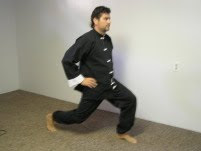
In the photo, I am standing in a Left Charging Horse Stance. To get in this position, stand with your feet shoulder width apart, hands on your hips. Take a step forward about one shoulder width, with the left foot. Keeping your back straight, let your body sink down as low as you can go. Ideally, you want to see the lower part of your back leg, in this case, the right leg, parallel to the floor. If you can not go that low, go as low as you can where it takes some effort to maintain the stance.
Hold this position as long as you can, then stand back up, and switch legs, stepping forward with the opposite leg. Start out by holding this position for 15 seconds for each leg, and work your way up to as long as you can, ideally for a minute with each leg. Always remember to keep your back straight!
This stance will help develop the strength of your legs, as well as balance. I also combine this stance with some work with a balance ball, dumbbells and body blades. Incorporating those items while working in this stance helps develop the balance even further by engaging the core muscles with more intensity.
Work this simple exercise into your routine and you will get fabulous results!
Scott Cole
For leg strengthening, we primarily worked on a variety of stances. One of the best of these stances is the Charging Horse Stance.

In the photo, I am standing in a Left Charging Horse Stance. To get in this position, stand with your feet shoulder width apart, hands on your hips. Take a step forward about one shoulder width, with the left foot. Keeping your back straight, let your body sink down as low as you can go. Ideally, you want to see the lower part of your back leg, in this case, the right leg, parallel to the floor. If you can not go that low, go as low as you can where it takes some effort to maintain the stance.
Hold this position as long as you can, then stand back up, and switch legs, stepping forward with the opposite leg. Start out by holding this position for 15 seconds for each leg, and work your way up to as long as you can, ideally for a minute with each leg. Always remember to keep your back straight!
This stance will help develop the strength of your legs, as well as balance. I also combine this stance with some work with a balance ball, dumbbells and body blades. Incorporating those items while working in this stance helps develop the balance even further by engaging the core muscles with more intensity.
Work this simple exercise into your routine and you will get fabulous results!
Scott Cole
Friday, November 20, 2009
Crunch Time For Aspiring Tour Pros
PGA Tour qualifying is under way this week, with the second round of qualifying being held at six locations around the country. The low 20 from each qualifier advance to the finals, which is often considered to be one of the most difficult events in the career of a tour pro. The finals will then be held December 2 to 7, where I believe the low 25 receive their PGA Tour cards. Those that don't make the cut will have some limited Tour opportunities or will play on the Nationwide Tour.
The Champions Tour completed its qualifying today. Only 5 players earned all-exempt status for the 2010 season. Finishers 6 to 12 receive conditional exemptions and the top 30 can compete for qualifying spots where opportunities are available. The list of players not earning their cards for the Champions Tour is dotted with lots of name players did not make the top 12, including Jay Don Blake, Chip Beck, Keith Clearwater, Tom McKnight and Bobby Clampett, among others. To make the top 5, players had to shoot 12 under for 4 rounds.
I always have tremendous respect for pros who endure these qualifiers. Some work their butts off for years before breaking through to the big show! But, it is work that they truly enjoy, just like the rest of us who enjoy this great game!
Scott Cole www.powergolftraining.net
The Champions Tour completed its qualifying today. Only 5 players earned all-exempt status for the 2010 season. Finishers 6 to 12 receive conditional exemptions and the top 30 can compete for qualifying spots where opportunities are available. The list of players not earning their cards for the Champions Tour is dotted with lots of name players did not make the top 12, including Jay Don Blake, Chip Beck, Keith Clearwater, Tom McKnight and Bobby Clampett, among others. To make the top 5, players had to shoot 12 under for 4 rounds.
I always have tremendous respect for pros who endure these qualifiers. Some work their butts off for years before breaking through to the big show! But, it is work that they truly enjoy, just like the rest of us who enjoy this great game!
Scott Cole www.powergolftraining.net
Subscribe to:
Posts (Atom)
